

Fear the Deer
the fear of the week

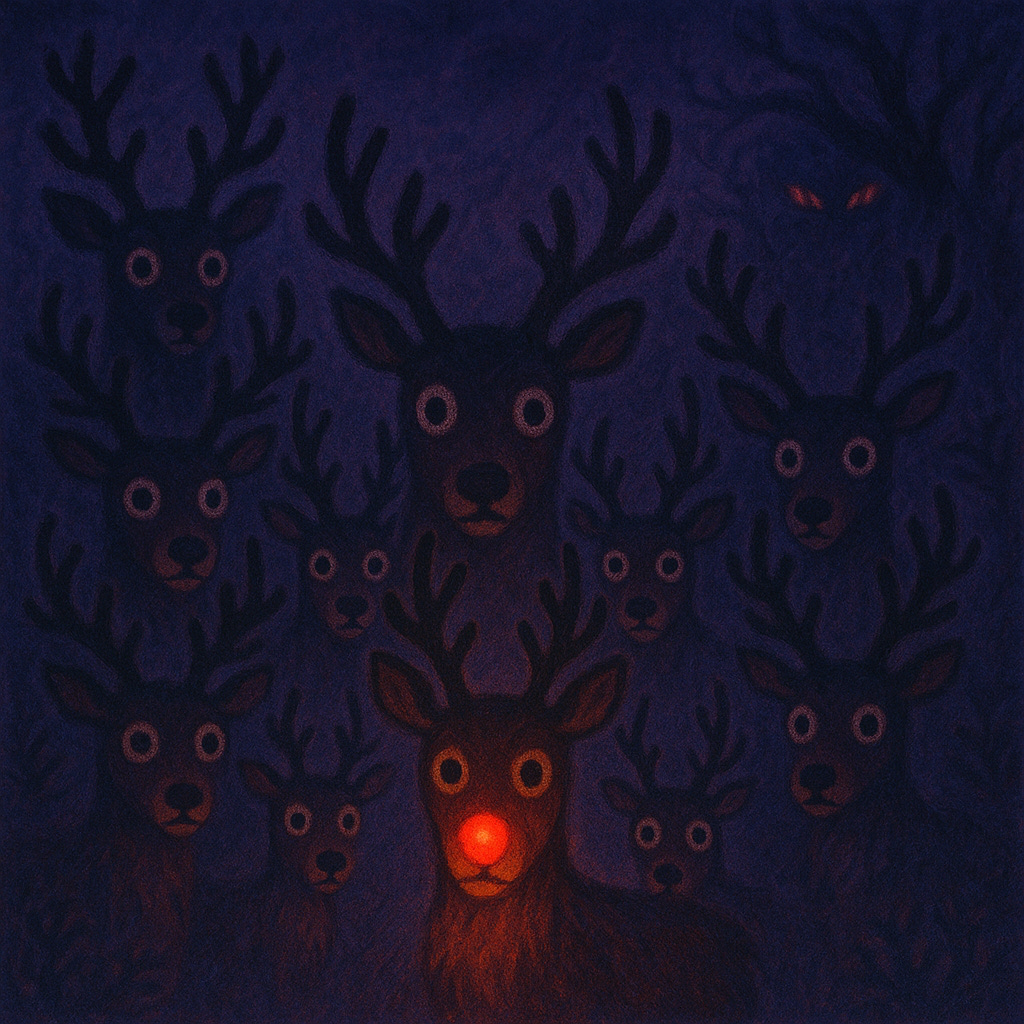
Tarandophobia: The Fear of Reindeer
Definition:
Tarandophobia is the irrational fear of reindeer – those antlered, hoofed symbols of the holiday season. For some, even images of them on cards or decorations can trigger unease, while for others, the sight of a live reindeer or even the idea of them overhead in the night sky provokes anxiety.
Real-World Resonance:
On the surface, reindeer seem harmless – even whimsical. But look closer. They’re large, powerful herd animals with antlers like racks of sharpened branches. Their hooves strike hard against frozen ground. They can be unpredictable, territorial, and frightening up close.
Layer holiday mythology on top of that, and they become stranger still. Flying herds thundering across rooftops, led by a glowing red beacon. Antlers silhouetted against the moon. A dozen heavy bodies crashing down in unison. What’s meant to be magical can feel uncanny – beasts too big and wild to belong in the carefully staged cheer of the season.
Even in decorative form, reindeer can carry an edge of menace. Wire-framed yard ornaments with glowing eyes. Taxidermy heads mounted above fireplaces. Plastic figurines frozen mid-prance. All reminders that beneath the songs and stories, they are still wild creatures – not pets, not playthings.
At its heart, tarandophobia shows how the line between festive and fearful is thinner than we like to admit. Reindeer are supposed to carry joy, but for some, they carry only dread.
Related Phobiac:
Raudulf the Redmaw
The story you know is not the story that was told. The cheerful carol of Rudolph the Red-Nosed Reindeer – the glowing guide of Santa’s sleigh – was never meant as truth, but as camouflage, or more accurately, a cover-up. A nursery-song ward, crafted to soften the memory of something no child should hear. “Do you recall, the most famous reindeer of all?”
The truth is the phobiac Raudulf. The Redmaw. The Ninth Reindeer.
Raudulf towers above the others, hide stretched taut over muscle, antlers jagged like blackened trees split by lightning. His breath steams in the cold like smoke from a pyre. Where the song says “nose,” there is only a maw – red not with light but with bloody froth, glowing faintly as though lit from within. His eyes burn ember-bright, unblinking, fixed on prey as if the night sky itself were his hunting ground.
His hide carries scars that glint like char, not fur but patches of soot and ash, as if he has passed through fire and brought its memory with him. His hooves strike sparks when they land, and the sound is a tinkling of bells that grows to a thunder.
Raudulf is dread in disguise, the monstrous kernel behind a myth polished into innocence. He is the reindeer no one dares name, rewritten as Rudolph to make the season safe for song and story. His power is twofold: his physical terror, and the revelation that even the most beloved traditions may be hollow masks, painted bright to distract from what really waits beneath.
Each chorus of “Rudolph the Red-Nosed Reindeer” is less a celebration than an invocation – another thread tightening the mask that hides him. Sing too loudly, believe too blindly, and the disguise slips, and the Redmaw steps through. The most infamous reindeer of all.
Grimm Stories:
Before they were bedtime stories, fairy tales were warnings. Cautionary myths whispered in firelight to teach children – and adults – how to survive the world. The early versions were full of blood and teeth: wolves that didn’t just huff and puff, but devoured whole families; stepmothers who didn’t ground you, but dismembered you; princes who weren’t always charming, and wishes that often came true in the worst possible ways.
Original Cinderella had doves peck out her stepsisters’ eyes. Sleeping Beauty was assaulted in her sleep. Little Red Riding Hood wasn’t rescued by a woodcutter; she was eaten, full stop. The old stories were blunt instruments, but they were honest: danger exists, and innocence doesn’t always win.
Over time, those rough edges were sanded down. The Brothers Grimm cleaned their tales for middle-class Christian families, toning down sex and amping up moral clarity. Then came Disney, who bleached the bones entirely – out went the mutilation and despair (I mean, rightfully so), in came the singing animals and happy endings. Horror was rewritten into hope.
Maybe that sanitizing wasn’t really for the children. Maybe it was for the grown-ups who didn’t want to admit how frightening the world still is. Or maybe they just wanted to sell stories easier. The monsters we face now just wear different faces.
That’s what I love about inventing phobiacs like Raudulf the Redmaw – the “real” Rudolph that the song and claymation tried to bury. A monster with a dripping red muzzle, leading the hunt instead of the sleigh. It feels close to the original spirit of those old tales – where the line between wonder and fear was paper-thin, and moral lessons came wrapped in menace.
I like to think Raudulf could headline a pretty great schlocky holiday horror movie. Something with dark red syrup, fake snow, twitchy stop-motion, and the kind of ending where you’re not sure whether to laugh or lock the door. Imagine the potential taglines:
All of the other reindeer used to laugh and call him names. They’re not laughing anymore.
Do you recall, the most infamous reindeer of all?
One foggy Christmas Eve…Redmaw came to play.
All of the other reindeer used to laugh and call him names. They’re not laughing anymore.
Chillingly good! (The red maw…shivers)
(Sharing this today with the high school student I write with. He craves myths/legends/gothic twists/Lovecraftian horror--and keeping it real.)