

Don't Look Now
the fear of the week

Optophobia: The Fear of Opening One’s Eyes
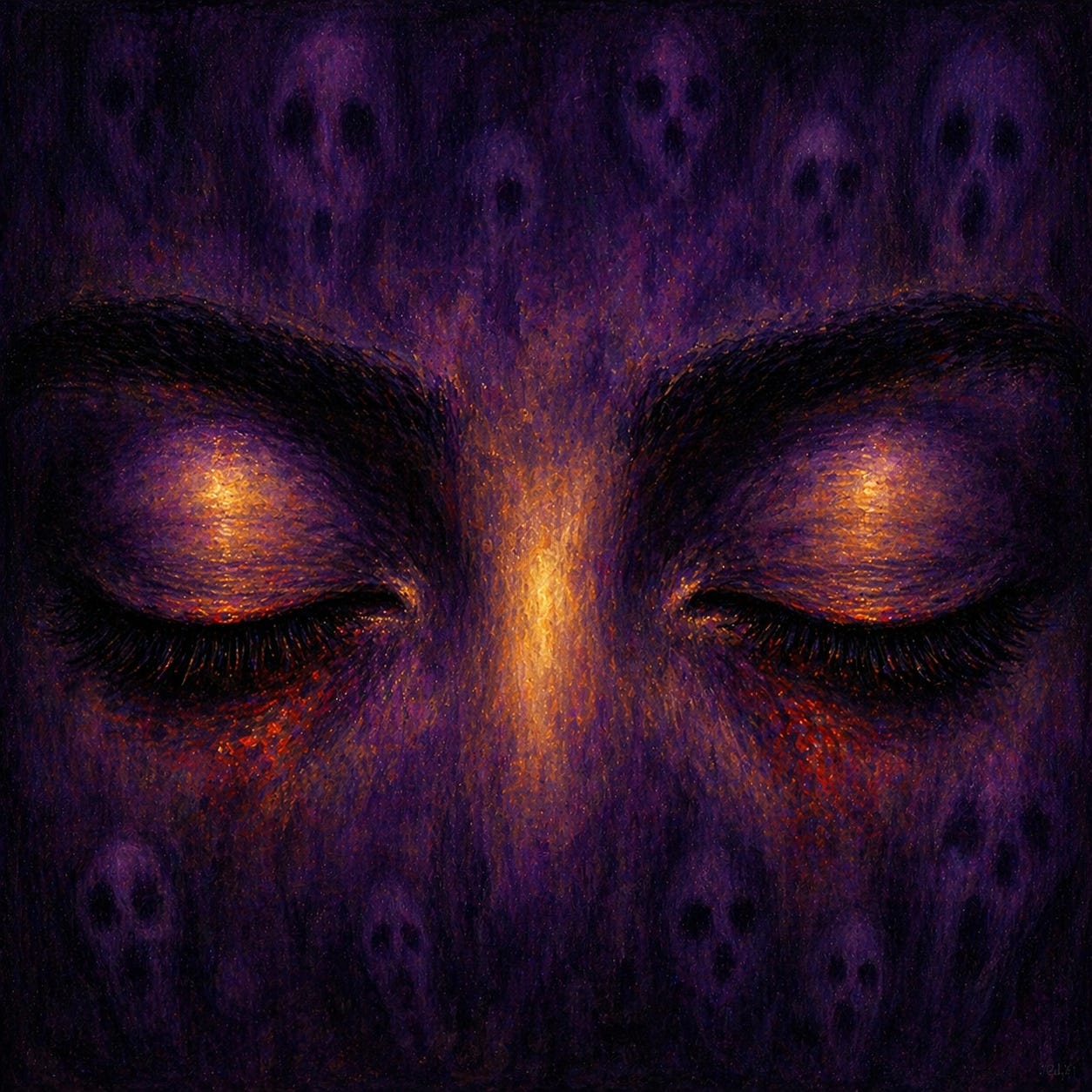
Definition:
Optophobia is the intense and persistent fear of opening one’s eyes. It can manifest as avoidance of light, prolonged eye closure, or anxiety around waking, often tied to trauma or the expectation that seeing something will trigger distress.
Real-World Resonance:
Most people think of fear as something you close your eyes to escape. Optophobia reverses that instinct.
The fear is not of what might be imagined in the dark, but of what will be there when you look. The moment between sleep and waking becomes uncertain. Eyes stay closed a second longer. Then another. Because opening them means confirming something – something you may not be ready to see.
Sight itself becomes a risk. It reveals. It fixes things in place. What exists becomes undeniable once it is seen. Avoidance isn’t about darkness – it’s about delaying certainty. Because as long as your eyes remain closed, whatever you’re afraid of is still unconfirmed. And there is a brief comfort in that.
Until you have to look.
Related Phobiac:
Liddy
Liddy stands very still, as if listening for the moment before something becomes certain. Her body is slight and colorless, the skin pale to the point of translucence. Veins show faintly beneath the surface. The features are soft, almost unfinished, as though shaped in a place where light was never required.
Her eyes are sealed. The lids are drawn closed and held with fine, deliberate stitches—thread pulled tight, each crossing precise. The skin around them is smooth, unbroken, as if it has healed that way over time. Not damaged. Adapted.
Liddy does not move like someone deprived of sight. She navigates without hesitation, stepping cleanly through space, turning at the right moments, stopping exactly where she should. Her head tilts slightly, as if sensing changes in the air rather than seeing them. The unsettling part is the pressure.
At times, the stitched lids strain. A faint tightening beneath the thread. A subtle shift, as though something behind them is not meant to stay unused. Not eyes, exactly – but the suggestion of something that once relied on them, and might again.
Liddy feeds on hesitation. The moment before opening your eyes. The pause between knowing and confirming. The instinct to remain still rather than risk what might be waiting when you look. Because as long as your eyes stay closed, nothing is fixed.
But in her presence, the fear isn’t just that you will have to open your eyes – it’s that she might. And whatever has been kept hidden behind those stitched lids will finally be seen. So terrible you can never unsee it.
Don’t Open Your Eyes:
I was living in California when 9/11 happened. I’d only been in Los Angeles a few months. I don’t remember exactly how I first heard about the plane hitting the World Trade Center. It would have been before 6 a.m. my time, so I was still in bed. Maybe my roommate knocked on the door. Or maybe I got a phone call.
I got up and looked at the TV, half-awake as I watched the coverage. Of course, at this time we all just assumed it was a horrible accident. I was about to go back to bed. I was working a lunch shift that day and wanted to get some more sleep. Then the second plane hit. And instantly, the feeling changed.
Now nobody knew what was happening. Only that whatever it was, it was bigger than an accident. The Pentagon. Another plane. Smoke. Sirens. Endless replayed footage. The entire country seemed to enter the same stunned silence at once.
After a while, emotionally overloaded and unable to process any more, I did go back to bed. I knew I wouldn’t actually sleep. But I remember lying there with my eyes closed, determined to stay that way as long as I could. Because I had the heavy feeling that once I opened my eyes again, the world would never be the same.
So I just lay there, thinking to myself: Don’t open your eyes.
Because as long as my eyes stayed closed, I could still pretend the world waiting for me was the same one as yesterday’s. As though keeping my eyes shut a little longer could somehow delay the inevitable.