

Button Up
the fear of the week

Koumpounophobia: The Fear of Buttons
Definition:
Koumpounophobia is the irrational fear or intense disgust of buttons. It can trigger anxiety, panic responses, or strict avoidance of clothing that features them. The fear often develops in childhood, sometimes tied to choking incidents, sensory aversion to texture, or associations formed early and never corrected.
Real-World Resonance:
Buttons are small. Common. Supposedly harmless. But for someone with koumpounophobia, the reaction is immediate and visceral. It’s not fashion. It’s proximity. Buttons sit too close to the body – hard, round, unmoving. They press where softness is expected. They fasten things closed. They don’t give when touched.
For many people, the fear centers on texture and placement. Hard plastic. Cold metal. The click against teeth. The memory of something small and solid where it didn’t belong, like a lump under skin. Even a cluster of buttons can trigger the same response – a reminder of choking, confinement, or loss of control.
Buttons are literally sewn into everyday life – school uniforms, coats, shirts passed down through families – so avoidance is practically impossible. Koumpounophobia turns getting dressed into something invasive simply because it’s too close to the throat, the chest, the skin.
Not because buttons are inherently dangerous, but because they are ubiquitous.
Related Phobiac:
Button
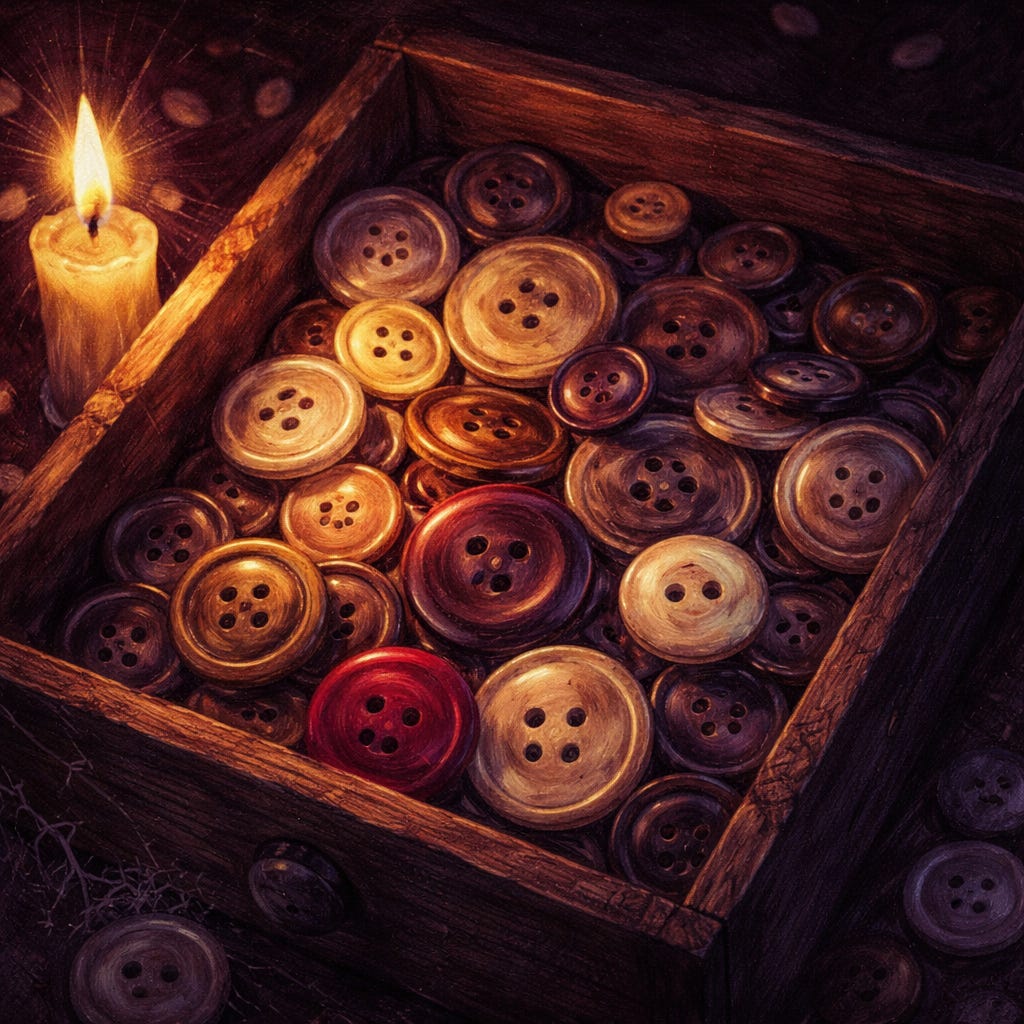
Like its namesake, this phobiac is small, but insists on closeness. Its body is round and rigid, composed of stacked discs pressed tightly together. The surface is smooth and cold, broken only by precise holes punched straight through. They suggest passage, but deny it. Nothing about Button yields. Everything about it resists.
Button shares a quiet kinship with Bobbin. Where Bobbin binds through tension and thread, Button holds through pressure and placement. One tightens space. The other fixes it closed.
It sits where softness should be, and you feel it – a hardness. On your body. At the throat. Along the chest. Too close for comfort. A solid interruption in the fabric of things.
It doesn’t move much. It doesn’t need to. Its power is in contact – the sensation of something hard fixed against the body, fastening fabric closed, holding space tight. The longer it presses, the more aware you become of it. Skin crawls. Jaw tightens. Breath shortens.
There is a sound to it. A dull clicking like plastic against teeth. Sharp like metal tapping bone.
Button feeds on inevitability. It seems to be everywhere – sewn so thoroughly into daily life that avoidance feels impractical, even impossible. The more you try not to notice it, the more aware you become of how close it already is.
The Hardest Button to Button:
My last few essays have been about bands I love. It is what it is, and I’m not apologizing for it. Certain artists stay with me because they show me parts of myself. They don’t just make songs – they reflect something back. A few go further, modeling ways of thinking about creativity itself.
Which brings me to The White Stripes.
Like most people, awareness came in 2001. Their third album, White Blood Cells, was the breakout. And like a lot of my musical discoveries at the time, I didn’t hear them first – I saw them. MTV, back when it still mattered.
“Fell in Love with a Girl” was the single, and its Lego-style music video made an immediate impression. You barely see Jack White or Meg White at all, and yet the aesthetic is unmistakable. Primary and primal. Even before you know the rules, you feel them.
When you finally do see them in person, you start to realize how deep it goes. Black. White. Red. Exclusively.
That trichromatic palette wasn’t just branding – it was ethos. Because musically, the White Stripes were doing the same thing. Guitar. Drums. Voice. Exclusively. I was bought in, because this to me was art. Music operating on a visual wavelength as well as aural. It was exciting to see how many different ways they could use these limited elements to create music and art.
I remember hearing “Seven Nation Army” for the first time – the lead single from their fourth album Elephant. The song opens with what sounds like a bassline, and for a moment I thought they’d finally reached their limit. They had to add a new thing to create something new. Then the reveal: no bass at all. Just Jack’s guitar run through a DigiTech Whammy pedal, dropped an octave. The rules were still intact.
Self-imposed limitation isn’t unique to the Stripes. Plenty of bands have done it. The Black Keys, rivals in spirit if not intent. Japandroids. The Presidents of United States of America, who took it even further – minimal drums, a three-string guitar, a two-string bass. PUSA have a permanent place in my heart because, for a while, “Peaches” was my son’s bath-time anthem. He’d queue it up nightly to sing along to in the shower and it made me smile. Then there was Morphine, whose “low-rock” trio – baritone sax, two-string bass, drums – felt like a dare: how much can we do with how little?
Then there’s the visual side. Committing to a look. For some that means costumes – KISS. Clinic, performing in surgical masks long before it became culturally loaded. I saw Clinic live once with holes cut into the masks – not ideal, but I admired the “commit to the bit” attitude. I prefer a subtler level, a cultivated identity. Think Interpol and their precision tailoring.
At the top tier, for me, there are only two: the White Stripes and The Hives – “your new favorite band” – who burst onto the scene with a howl and a rigid black-and-white look they’ve never abandoned.
But even among those, no one committed to the rules quite like the White Stripes. Color. Sound. Myth. Limitation as identity. Why does that matter?
Because creativity is born from constraint. Rules unlock imagination. A blank canvas with an infinite palette can be paralyzing. When you can do anything, what should you do? But restrict the colors to red, black, and white, and suddenly the question changes. Not what do I do with all of this? but what can I do with just this?
I think real artists do this instinctively. The novice stares at the unwritten book and thinks too big. The experienced writer invents a boundary – a premise, a problem – and starts working within it.
Since the White Stripes disbanded, Jack White has reinvented himself more than once. Added new rules and colors. Expanded the palette. That makes sense. You learn what you can inside the constraints, and once you’ve mastered them, you don’t just break the rules. You write new ones. You start playing a new game.
So I’ll always admire what the White Stripes proved: that limitation isn’t a weakness. It’s a strategy. And sometimes, the most distinctive voice you can find comes from deciding what you’re willing to leave out.
✨